Writing About Writing, pt. II: the process
This series is intended for a person who wants to write more and is curious about the tools and processes. Specifically my tools and processes. If you just came from part I you know I think the best way to generate writing ideas is by reading.
The problem is that if you read a lot, you presumably end up having pretty high standards for what you like reading. So that's what you think the "outcome of writing" should be. Prepare for your writing to not look anything like that at all. It will suck. And you will feel deflated. Welcome to writing.
This post is about how to get past that.
it will be sh*t
Everything I read about writing always acknowledges this point. Because you don't just want to write, do you? You want to write good. If the aim is just to write, you could sit down and write the same word over and over again, until you hit whatever wordcount you were after. That's not the point.
The point is to communicate through writing. To convey ideas, compellingly. To use your words well. To paint a picture with a kaleidoscope of colours using only the black on white. To make the words jump off the page and tell a story and string people along with your thoughts. To make them come alive.
That's what you want. You don't care about word counts. You don't care about some daft writing exercises. You want the magic. Ira Glass put it best with the longest-ass quote ever to circulate the internet, but it captures the truth. And if the truth needs to be long, so be it.
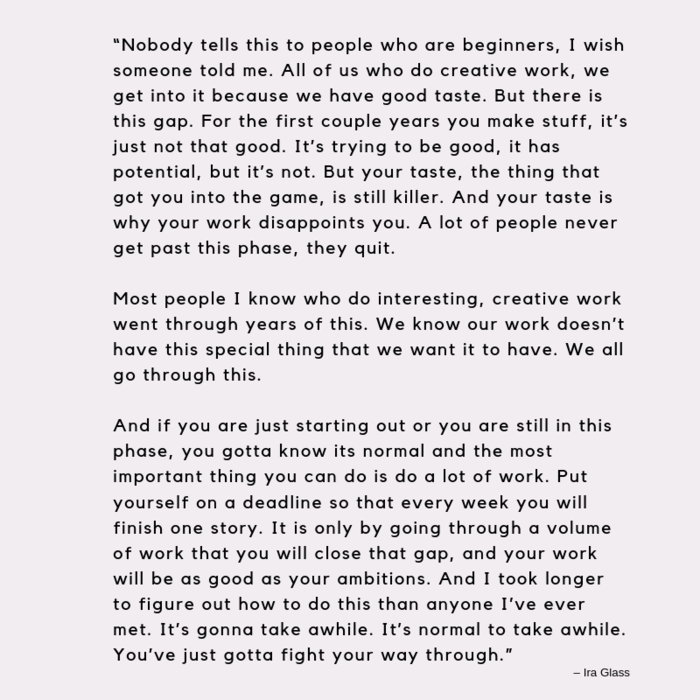
Your taste, that Ira Glass describes as killer, is your editor. And this editor needs something to work with. The problem is, that the only thing a beginner is able to produce doesn't meet this editor's standards. Which is very disheartening.
This permission of producing without judging goes against our instincts.
Because it's gonna suck. And we want magic.
To Write Good
write bad. literally anything will do.
When you sit down with a body of text in front of you, there are only two ways it can go. You can make it longer, and you can make it shorter. The writing part is slamming on the keyboard to make it longer, the editing part is cutting it down and making it shorter. One makes it good, the other brings it into existence.
And that’s just it. You can't edit when there's nothing to edit. And it won't be good until there's something, literally anything, there. Because while editing makes it good (and good is good) there is literally nothing in the world that exists without the initial keyboard-slam (which won't be very good).
Be very careful of the idea in your mind that you like versus the words on the page that you don't. We're working on it. This is the process.
There's no way to say this without sounding crazy, but writing is the meeting of your own two minds: the creative and the logical. Because to write well, two things need to happen: you need material to work with which requires a creative process to generate, and then you need to make it follow the rules (of grammar, structure, cohesiveness, etc) i.e. editing with your logical brain.
Every single authority on this topic seeks to 'break' our editor and have it accept whatever garbage we spill out initially as just that. Garbage. Also known as a shitty first draft. Also known as many other things. The absolutely critical thing is to be able to shut off your analytical brain to get there. Don't edit while writing.
Writing well is a two-stage process: (1) write not so well; (2) fix it. -- Jim Holt
— Ben Casnocha (@bencasnocha) May 25, 2017
When you hear of someone 'staring at a blank screen', they're struggling to separate these two parts of the process. They want to perfectly craft a story, right away on the first go without a running start. They want the first sentence written to be the first sentence published. They want to edit. Have the logical brain in charge, like it normally is. But it has nothing to work with.
Just spew your stream of consciousness without much thought on the page. Trust that any errors or structural problems or personal notes you might make to yourself or references that need to be looked up, will be dealt with by your much more capable editor.
This is such a big important step that there are a plethora of products created just to facilitate this process. I'm going to talk about two. In this post >>
Congratulations
you now have a pile of garbage
One of my two big a-ha writing moments is that writing and editing are not the same thing. Writing is for your creative brain to spew out whatever is on your mind. Editing is to make it good. Find the point you're making. It's literally the process of finding anything worth salvaging in there.
What's really interesting at this point, is we have set out to produce garbage. But as soon as it exists in the world we get attached to it. Suddenly we're like "I made that". "Should I share it?". No. You've just spewed out some garbage. Now the logical, practical, meticulous, analytical brain can finally get to work.
I have spent 2 hours writing something as in just throwing it together and 3 days editing. Easy. Editing is where you look up the references. Editing is where you find the gaping holes in your logic or storyline. Editing is when you check the spelling, and the structure, and the cohesiveness, and the allure of it.
Editing is when you realise you made a wrong assumption 28% of the way in, and now your conclusion is wrong. There's a lot of writing that happens in editing, don't get me wrong, but it's different. It's patching and polishing what your creative side produced.
my two big a-ha moments
:: writing and editing are not the same
:: not everything written should be published
To Edit
Editing is the act of taking something that has potential and making it good. Due to the rigorous effort required, it's hard to justify this work without a purpose. And the purpose is normally that your piece is intended to be published.
Just because you wrote something, doesn't mean it needs to be shared, like I said in part I. This ended up being my other major a-ha writing moment, that writing doesn't need to be published or even shared. Some things are private. Things that are public reflect on you, so what it is matters.
But also sometimes, what you wrote is just not very good... yet.
What we call “writing” is actually made up of three distinct activities: coming up with ideas, turning those ideas into drafts, and then editing those drafts into publishable pieces.
– Jeff Goins, here
it's a draft
and it's okay if it sucks
I used to conflate drafts with something that was ready to be published. It created this big frustration why I wasn't publishing more of my writing. But my writing wasn't ready to be shared yet, because it wasn't done.
It will never not surprise me how something seemingly obvious can be told to you many times, and you only hear it when you're up against it yourself. Acknowledging my piles of garbage as drafts was very helpful.
When I read Jeff Goins' article, a long time ago now, I had one of those woaah dude moments when he very simply and very briefly explained that he has different buckets for different stages of his projects. One for ideas, one for drafts, and a final one for pieces that are ready to be published.
Systematise
with apps / products / platforms
This creates three types of 'documents' or collections. Acknowledging them as such can make it a lot easier to work with.
Ideas
Drafts
A Publishable Piece
And this is where we as citizens of the modern world are spoiled rotten for options. We can jot down notes whenever they come to us as described in part I.
When the idea has enough substance, we can move it into a writing platform and get a draft together. And then, when it's ready to transition into a polished piece, we can move it into a publishing platform.
This series is for the person who wants to write more and is curious about the tools and processes. Specifically my tools and processes. Those are covered in part II and III and if you already have ideas, you can skip straight to those.
This post lays out how to collect ideas and the process of recognising if they have potential or a message worth passing on. As for writing motivation, that will not be covered here. I can recommend Julia Cameron's The Artist's Way or any of Austin Kleon's work for that.
What we call “writing” is actually made up of three distinct activities: coming up with ideas, turning those ideas into drafts, and then editing those drafts into publishable pieces.
– Jeff Goins, here
I almost skipped ideas...
It's hard for me to convey in nice words how little I value ideas. Almost any idea can be good when it's executed well. An idea without execution is ephemeral, intangible and leaves little if anything behind.
I'm interested in the execution, in honing the craft of communicating a feeling or a frustration in a way that invites empathy and understanding or even action.
Maybe it's because ideas come easily to me, at least now that I've gotten in the habit of collecting interesting links, quotes, phrases, and writing down observations.
Insight, Vision, Inspiration
learn to listen
What I do love though, is vision.
I love work that has intent, a story that's almost bigger than itself and I recognise that comes from inspiration. I also think any cracks in the work are more easily forgiven when the vision is strong enough.
And getting into the habit of finding inspiration is a skill you can hone. Whenever you read/watch/listen to something, do you ever want to add your own two cents? Do you ever want to jump in with a personal anecdote? Do you ever have an insight that would deepen the story or offer a fresh perspective?
That's inspiration. And the big trick here is to not think "oh, this idea is so good -- I won't be able to forget it". Because you almost certainly will forget it altogether, and quicker than you think.
So the first step is getting into the habit of jotting these things down. You can carry a notebook with you, or you can write them down in your phone. Whatever is closest is probably the best option, because like I said, these ideas or clever play of words you've come up with will likely exit your mind as quickly as they entered it.
To Write, Read
Inspiration can come from anywhere. For me, it comes from reading. I read and read and read and read. And read. This is books and reports sure, but also articles and people's thoughts on social media, and messages from my friends.
I believe reading begets writing. To write, read. That's how you get into the rhythm of text and how it flows. As a better reader, you'll also be able to tell if your writing 'reads well'.
When I know I have writing tasks that day, I'll still start the day by reading. I'm not here to give you a scientific breakdown of how that works, but writing without reading is like driving without fuel. Where are your words coming from? Read to find them.
If you want to write in English, read in English. If you want to write in a different language, read in that language first.
Reading generates ideas. Writing is the response.
What are you writing for?
So ideas, and even drafts (more on that in part II), come easy to me. My problem is producing something that is polished enough to exist outside my own personal notes.
I write to stay in communication with the world, and if it's not out there – what's the point? Well, I'm learning that there are valid reasons to write that aren't publishing. Writing can be personal discourse, or a professional skill, or used almost as meditation (journaling).
For me writing just kinda spills out of me when I'm frustrated or angry or heartbroken or really trying to understand something. I have written 2000 words on my phone at 1 am when I can't sleep because something is bothering me. Many times.
One Miss Swift is not the only one who has a hundred thrown-out speeches penned to an ex, and they are thrown out for a reason. They along with stream-of-consciousness rambles or incomplete work documents have no place in the world.
All of this is to say my skill when it comes to writing is recognising when it should be passed on, privately or published publicly, and what is better left unsaid.
